
There's a version of this conversation you've already heard a hundred times. AI is coming for marketing jobs. AI is going to replace creative work. AI will rewrite strategy, replace agencies, and turn CMOs into prompt engineers with a LinkedIn headline.
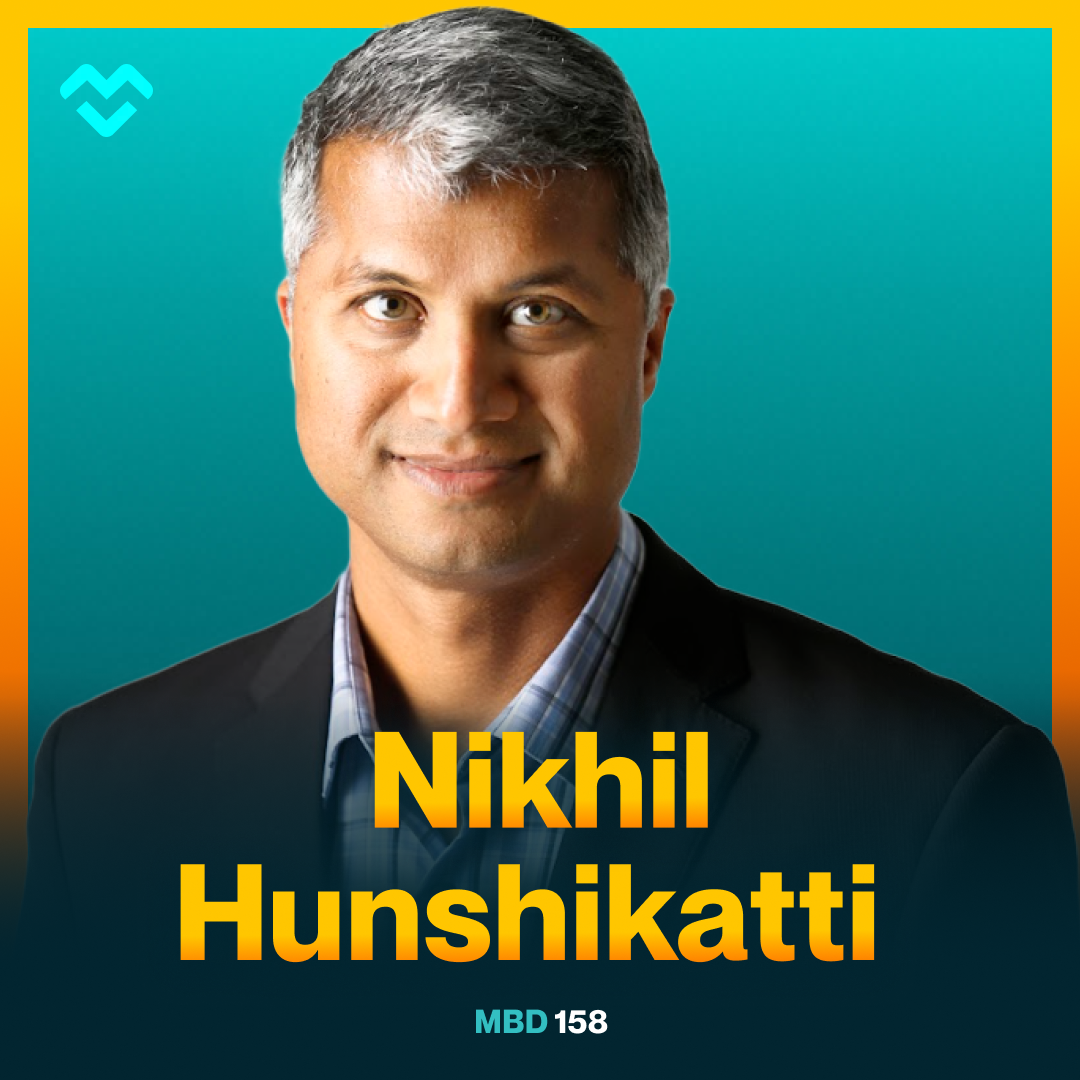
Nikhil Hunshikatti has heard it too. He just doesn't believe most of it.
Nikhil is a fractional CMO at YorCMO, and he's had one of the more unusual career arcs in marketing. He started at Ogilvy & Mather in Mumbai, moved to the United States in 2002 to get his MBA from Illinois, and landed at the Chicago Tribune through a phone call so well-timed it almost sounds made up. I'll come back to that phone call in a minute, because it matters.
What matters first is the operating principle Nikhil uses to navigate a moment where every marketer is being pressured to adopt AI faster, cheaper, and with less oversight. His version of it is simple.
"Hemingway said write drunk, edit sober. My philosophy is write AI, edit human."
That one line does more work than most of the AI strategy decks I've read this year.
The Phone Call On Lakeshore Drive
In 2004, Nikhil was about to graduate with his MBA and the job market for international candidates in advertising had collapsed. The dot-com bust had made agencies gun-shy. Nikhil had already interned at the Chicago Tribune the summer before, twelve weeks of marketing analyst work on one of the most iconic brands in American media, but there was no full-time role waiting for him.
So he did what you do when the dream isn't cooperating. He signed up to be a door-to-door salesman in Milwaukee.
The weekend before graduation, Nikhil was driving back to campus on Lakeshore Drive in Chicago, literally passing the Tribune Tower, when his former internship boss called him and told him a marketing analyst role had just opened up. He took a quick turn, signed the papers, graduated, and moved to Chicago in a car over the weekend.
That kind of timing is cinematic, and it's easy to read it as luck. But Nikhil's own takeaway is different. The call only happened because he had spent twelve weeks doing unglamorous work inside an organization that remembered him.
Internships Are Not Supposed To Be Sexy
This is where Nikhil gets fired up, and for good reason. He's watching a generation of marketing students walk into internships with expectations that don't match reality.
"Nothing about an internship is sexy," he said. "Internships are meant to expose you to parts of the organization that never see the light of day."
His internship at the Tribune was a deep-dive into classified ad data. All day, every day, spreadsheets. He was analyzing a single vertical (general merchandise, which is basically what eBay is today) and identifying trend lines over three to five years to help the Tribune figure out how to transition that revenue into digital.
The recommendations from that internship fed directly into the conversations that eventually spun out Classified Ventures, the joint venture that became Career Builder and Cars.com.
A kid on a spreadsheet helped shape a strategic pivot for one of the largest news organizations in the country.
His advice to marketers starting out is worth quoting directly: use internships as stepping stones to understand what really resonates with you. Marketing is huge. Research, product, design, performance, analytics, content, merchandising. You won't see most of it until you're inside an organization, and once you're inside, people open doors that stay closed to outsiders.
If you're in school right now and reading this, the lesson is this: stop optimizing your internship for visibility and start optimizing it for exposure.
Write AI, Edit Human
Now we get to the part that matters for every marketer reading this right now.
Nikhil uses AI constantly. He's not precious about it, and he's not afraid of it. But he has a very specific point of view on how it should sit inside a marketing workflow, and it comes down to that one line: write AI, edit human.
"AI is not a strategy. It's an aid to drive your strategy."
The distinction matters. AI can draft, summarize, analyze, accelerate, and inspire. What it cannot do, at least not yet, is the thing Nikhil thinks of as the core of marketing work: stitching together insights from different parts of a business into a coherent narrative that a leadership team can act on.
He walked me through a real example. A prospective client recently sent him a massive data dump. Nikhil's first move wasn't to feed it into a model. It was to parse it himself, look for patterns, and build a hypothesis about what was actually going on inside that business. Only after that did he ingest the data into his AI tools, and even then, the prompts he wrote were shaped by the context he had already built in his own head.
The AI handled the heavy lift. The human handled the interpretation. The output got ported into Gamma for the final executive presentation. The result was fast, sharp, and defensible.
That's the workflow. And it's the opposite of what a lot of marketers are doing right now.
The AI Slop Problem
One of the more honest moments in our conversation happened when I read Nikhil a post from a CMO community. The author was venting about vendors and contractors handing in work that was clearly just raw AI output. Five pages of "SEO feedback" that was obviously lifted straight from ChatGPT. Design mockups that looked like nobody read the brief. Comments that flagged problems that didn't exist.
Her fear was simple: she was losing faith that she'd be able to find good freelancers at all.
Nikhil's response was even simpler.
"The moment you start regurgitating what an AI tool gives you, it opens the door for conversations about replacement. What value are you adding to the organization if I can do the same job with an agent?"
That's the trap. Marketers who use AI to skip the thinking are training their clients to skip the marketer. The value of a human on a project is context, judgment, empathy, and institutional knowledge. The moment you hand in work that any AI could have produced, you've made the case for your own redundancy.
The counter-move is obvious but unpopular: slow down. Do the human part. Read the brief. Talk to the customer. Build the hypothesis before you build the deck.
The Skill AI Will Never Replace
I asked Nikhil what part of marketing will hold its value longest, and he didn't hesitate.
"Understanding human behavior and consumer behavior is the core of marketing. That's the why. And understanding why requires humans talking to humans."
He thinks consumer psychology is going to become more valuable, not less, as AI eats the middle layer of marketing work. The logic is clean. If AI can execute the "how," the premium moves to the "why." And the "why" lives in research, empathy, and conversation with actual people.
This is also where Nikhil made one of the sharpest points in the whole episode. He thinks brands aren't going away in an AI-driven world, but the signals that influence brand perception are going to change. Right now, brands drive decisions through perception. In an AI world, AI agents are going to watch how users behave around a brand, how they retain purchase cycles, and what kind of reviews they leave, and those signals are going to influence future recommendations.
Which means the job of marketing becomes less about manufacturing perception and more about creating real experiences that generate good signals.
Why Agentic Checkout Won't Buy Your Fence Panel
Nikhil gave me the best analogy I've heard for the limits of agentic AI so far.
"I can ask Grok to buy me a toothpaste while I'm driving. Very easy. But can Grok buy me a fence panel for my backyard with all the boards, the gates, the posts, and the lighting? That's not easy."
Simple, low-consideration purchases are going to get automated. Complex, high-consideration purchases, the kind that involve personal preference, touch and feel, and real stakes, are going to stay human. That's a useful filter for marketers trying to figure out where their category sits on the AI disruption curve. If your product is a toothpaste, start worrying. If your product is a fence panel, a healthcare system, or a B2B software platform with a six-month sales cycle, the human is still in the loop.
The 90-10 Rule
I ended the conversation with a question I wasn't sure he was ready for, and honestly, neither was I. I asked Nikhil what he tells his kids about navigating an uncertain future.
His answer was three principles.
The first is the credits versus debits philosophy. Every decision you make (a relationship, a job, a partnership) either adds credits or adds debits to your life. Stack up more credits and you'll end up in a good place.
The second is the 90-10 rule. "Focus 90 percent of your time and energy on the things you control. How you deal with the 10 percent you don't control is what guides the rest."
The third is the part that surprised me. "Be good to people. Be good to yourself. And stay off the damn phone."
I've interviewed a lot of high-performing marketers and founders on this show, and when the conversation turns to family, almost all of them say the same thing. They don't care about whether their kids go to Harvard. They care about whether their kids grow up to be good humans. Nikhil is in that camp, and it shows up in how he runs his client work too.
What To Take From This Episode
If you're a marketer trying to figure out what to do with AI right now, Nikhil's frame is the cleanest one I've heard all year.
Write AI, edit human. Use it for the draft, not the decision. Use it for the pattern, not the interpretation. Use it to accelerate the parts of your job that don't require judgment, and then spend the time you save on the parts that do. And if you're handing in work that a language model could have produced on its own, you are quietly making the business case against yourself.
The marketers who are going to thrive over the next five years are the ones who get sharper at the human parts. Research. Strategy. Context. Judgment. Empathy. The parts you can't fake and can't delegate.
That's the work. That's the edge. And that's what Nikhil has been doing, one unglamorous spreadsheet at a time, since the Tribune Tower.
Want to go deeper?Listen to the full episode with Nikhil Hunshikatti on Marketing by Design wherever you get your podcasts. Connect with Nikhil on LinkedIn or at hunshika.com. And if you want to see the exact design patterns I use to build high-converting websites for B2B and healthcare companies, grab the free Visual Swipe File at mmg.studio/visualswipefile.
And that, is marketing by design.










.avif)






.avif)

























.avif)

.avif)
.avif)
.avif)
.avif)
.avif)
![[GREATEST HITS] Lacey Picazo on Differentiating Yourself as a Marketer/Creative in Columbus](https://cdn.prod.website-files.com/697bc5477a07f38cecb116d4/6993c46884f01f1608ed863d_67edf1ef876dadc49a875b6b_Lacey%2520Spotify.avif)
.avif)

.avif)
.avif)
.avif)
.avif)
-1.avif)

.avif)
