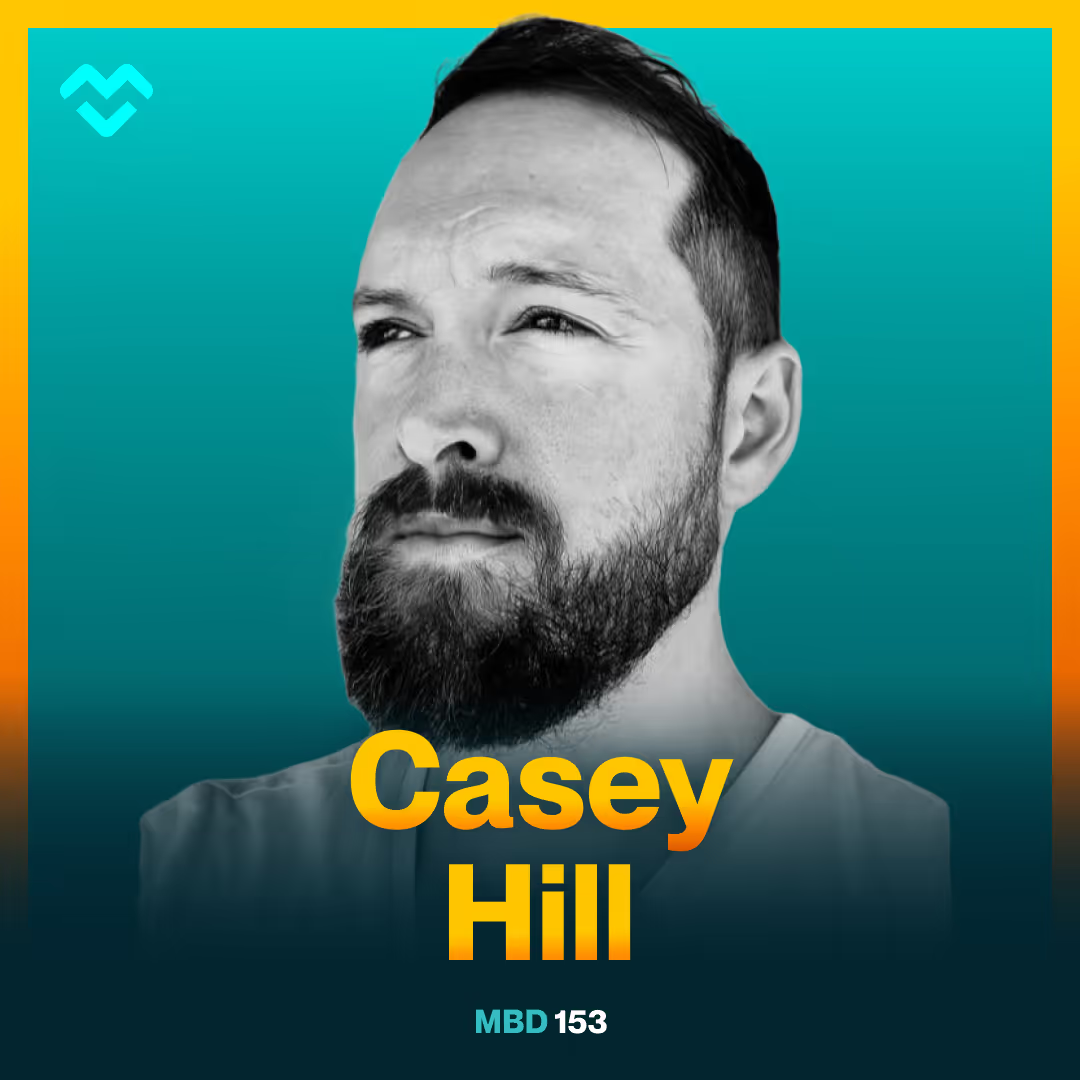
Casey Brown's TED Talk has been viewed over 4.5 million times. The title is simple: "Know Your Worth, and Then Ask for It." But the reason it resonated with millions of people is that it touches something most of us feel but rarely talk about out loud: the gut-wrenching discomfort of putting a number on ourselves and saying it to another human being.
Casey is the founder of Boost Pricing, a consulting firm that works with sales teams to negotiate better deals and close at higher prices. She's also the author of Fearless Pricing and a keynote speaker who has spent 25 years in this space. She sat down with me on Marketing by Design to talk about why so many talented marketers, creatives, and founders are chronically underpaid, not because they lack skill, but because they lack the confidence and the structures to communicate what they're actually worth.
This conversation hit close to home for me. If you've ever folded on a price, discounted in the moment, or walked out of a meeting thinking "why did I just do that," this one is going to stick with you.
The Real Reason You're Underpaid Has Nothing to Do with Your Skills
One of the first things Casey said in our conversation is something that should be printed and taped to every freelancer's monitor: having good work is only half the battle. The other half is communicating it.
She broke it down simply. You can have the best product or service in the world, but you will never be paid what you're worth unless the other party understands that value. It sounds obvious when you read it. But look at how most creatives and marketers actually behave when it comes time to talk about money. They rush through it. They minimize it. They say the number quietly and then immediately start justifying why it's not that high.
Casey sees this pattern constantly, and she traces it back to a few root causes. Fear of rejection is the first and biggest one. There's a concept in neuroscience called the negativity bias, which means we recall negative events with far more intensity than positive ones. You can hear ten "yes" responses, but the one "no" is the thing that rattles around in your brain for weeks. When you sell professional services and you are the service, a "no" doesn't feel like a rejection of a product. It feels like a rejection of you.
Why Creatives Are the Worst at This
Here's the part that really stuck with me. Casey pointed out that marketers and creatives are excellent storytellers and messengers. They build brands, craft narratives, and communicate value for a living. But when it comes to their own business, they go quiet. It's the cobbler's son with no shoes.
She described it as a mix of fear, discomfort, a misunderstanding of the importance of the work, and a genuine belief that selling is beneath them. A lot of creatives treat sales like a necessary evil, the thing they have to do so they can get back to the work they actually enjoy. Casey's reframe on this is powerful: selling is serving. Her definition of selling is making good information available to someone so they can make a prudent choice for themselves. That's it. No manipulation. No pressure. Just helping the other person understand what you do and why it matters so they can decide for themselves.
That reframe matters. Because when selling feels slimy, you rush it. You underprice. You skip the part where you explain the full scope of what you deliver. And you end up being the best-kept secret in your market.
The Price-Quality Effect and the Danger of Being Too Cheap
One of the most useful concepts Casey introduced in our conversation is the price-quality effect: the tendency for people to infer quality from price. If something is expensive, we assume it must be good. If it's cheap, we assume something is wrong with it.
Casey shared a story from her own experience. She was hiring for marketing support and the person they liked best came in at about 20% of what everyone else quoted. Casey's immediate reaction was doubt. She thought, "I don't think she can be any good." That may not have been true, but the low price created suspicion. Casey eventually hired her and plans to tell her to raise her rates when the project wraps. But the lesson is real: when you use price as an inducement to get people to try you out, you're signaling low quality whether you intend to or not.
This is especially dangerous for people in the startup phase of their business. Casey sees it all the time. Someone has spent years, sometimes decades, building expertise. They finally launch their own thing. And then they discount all that experience because they've only been in business for six months. The market doesn't know about your decades of expertise unless you communicate it. And your price is one of the loudest signals you send.
Asymmetrical Feedback Is Eroding Your Confidence Right Now
This was maybe the most eye-opening moment of the conversation for me. Casey explained what she calls asymmetrical feedback. When it comes to pricing, you only ever hear one side: the negative side. Customers who think your price is too high will tell you. Customers who think it's fair, or even a bargain, say nothing.
And it gets worse. Some of the negative feedback isn't even real. Casey does an exercise in her keynotes where she asks the audience how many of them have ever offered less than the sticker price at a store or a garage sale. Every hand goes up. Then she asks how many would have paid the full price if the seller had said no. Hands go up again. These aren't bad people. It's human nature. We try to hold onto our resources. But when you're on the receiving end of that, you don't know if the pushback is genuine or just a negotiation tactic.
Over time, that one-sided feedback erodes your confidence without you even realizing it. You were set to "nine," but the constant drip of price resistance slowly dials you back to eight, then seven, then six. And unlike a machine, you don't stay where you're set. You drift. Casey says this is exactly why she describes her real job not as pricing consultant but as confidence coach.
The Zip Code Exercise
Casey shared one of the simplest and most effective reframes I've heard for pricing fear. She asked me my zip code. I told her. She said, "That's too high."
Obviously, that's absurd. Nobody gets nervous saying their zip code. There's no emotional charge to it. Casey's point is that a price is just a number, just like a zip code. Now, she's not naive enough to say you'll ever be completely emotionless about quoting a price. But the spectrum between zip-code comfort and paralyzing fear has a lot of room in the middle, and most people can move meaningfully toward the comfortable end just by getting more reps.
She followed this with another practical approach. Instead of picking a price that feels safe, pick the number that scares you but wouldn't keep you up at night. If you think $3,000 is right, ask yourself what number is terrifying but you could still put your head on the pillow. Maybe it's $4,500. Say that number. See what happens. If four out of five clients say yes, that's your new standard. And if you're winning 100% of your deals, you're definitely underpriced.
Never Discount in the Moment
This was the structural rule that I think will save a lot of people a lot of money. Casey's rule is simple: never, ever discount in the moment.
If a client pushes back on price in a conversation, have a prepared phrase ready. Something like: "I understand your budget is lower than what I've proposed. With your permission, I'd like to go away and come back to you, maybe with some questions that allow me to rescope this in a way that meets your budget while still delivering on the promise. Can I come back to you next week?"
This does two things. It prevents you from folding in the emotional heat of a face-to-face conversation. And it gives you the space to think clearly, without the amygdala running the show. Casey was very clear: you might discount later. But you never do it in the moment. Especially if you know you tend toward people-pleasing or what she calls "Midwest nice."
The Midwest Nice Tax
Casey acknowledged that underpricing is a problem everywhere, but she's seen it less on the coasts and more acutely in the Midwest. She called it the Midwest Nice problem. There's a cultural humility that's wonderful in many aspects of life but brutal for your bank account when it's over-indexed.
Her advice for people stuck in that mindset: build structures around your habits. You're not going to wake up one morning and suddenly feel comfortable quoting big numbers. But you can build rules and routines that protect you from yourself. The "never discount in the moment" rule is one of them. Preparing for objections before a call is another. Reviewing your business financials regularly to stay connected to the objective reality of your business, separate from your identity, is another. Casey goes deeper on all of this in Fearless Pricing, which is available on Kindle for under $10.
Brain Science and the Sales Conversation
Casey is a self-described brain science geek, and the neuroscience she brought into the conversation was some of the most actionable material in the episode. When you feel afraid in a pricing conversation, your amygdala takes over. That's the part of the brain responsible for fight or flight. It's not sophisticated enough to differentiate between a saber-toothed tiger and a client saying, "That's more than I expected." To your amygdala, both are threats to your survival.
When the amygdala takes charge, you stop listening. You start scrambling. You start negotiating against yourself. Casey said it plainly: in fight or flight, you're no longer even hearing what the other person is saying.
The antidote is preparation. Not memorizing every detail about your prospect. But spending 10 minutes before the call asking yourself: what are the ways this conversation might go? What might they push back on? What will I say if they bring up a lower competitor? What's my opening line? What do I want the outcome to be?
This kind of preparation keeps you in your neocortex, the rational, logical part of your brain. It keeps you present. And it keeps you from doing something in the moment that you'll regret on the drive home.
Pricing Is Like Poker
Casey closed with an analogy that tied the whole conversation together. She compared pricing to poker. In poker, the cards you're dealt are only half the game. The other half is how you play them. Your product or service is the hand you're dealt. How you communicate that value, how you position it, how you hold your nerve in a negotiation, that's how you play it. And the people who play it well earn dramatically more than those who don't, even when the hands are comparable.
This is why Casey gets out of bed every day. She sees businesses producing truly exceptional work that are not getting paid for that excellence. And to her, that's an injustice. Because when a business gets underpaid, they can't invest in their team, their community, or the growth that would multiply their impact. Some of that money belongs to them. It's just sitting in somebody else's bank account because they didn't communicate clearly enough to get it back.
Where to Find Casey Brown
Casey has resources for every stage and every budget. Fearless Pricing is available on Kindle for under $10. Her website at caseybrown.com has speaking information and free resources including blog posts, videos, and calculators. For sales teams that need hands-on consulting, Boost Pricing works with companies directly. And she's active on LinkedIn, where she posts regularly and accepts all connection requests.
If you're someone who pours your heart into delivering excellent work but feels a knot in your stomach every time it's time to talk about money, Casey's work is the best starting point I've found.
⚡️ Want to see how high-performing companies turn their websites into their best salesperson? Check out the Visual Swipe File.











.avif)





.avif)


























.avif)


.avif)
.avif)
.avif)
.avif)
.avif)
![[GREATEST HITS] Lacey Picazo on Differentiating Yourself as a Marketer/Creative in Columbus](https://cdn.prod.website-files.com/697bc5477a07f38cecb116d4/6993c46884f01f1608ed863d_67edf1ef876dadc49a875b6b_Lacey%2520Spotify.avif)
.avif)

.avif)
.avif)
.avif)
.avif)

-1.avif)