Put your hand over the logo
Matt gave me a test I've been running on every healthcare website I've looked at since we recorded.
Go to a practice's homepage. Cover the logo with your hand. Now ask: could this be any orthopedic group in the United States?
For most of them, the answer is yes. Same blues. Same stock photo, or AI-generated image, of a doctor pointing at an iPad while a patient smiles a little too hard. Same "compassionate, patient-centered care" tagline.
I see this constantly in my own work. I build websites for healthcare companies, and the first draft of almost every brief asks for the same things everyone else already has. It's not because the people writing those briefs lack taste. It's because the industry rewards playing it safe.
Why healthcare plays it so safe
Matt works with more than 30 private equity-backed healthcare platforms, so he sees the incentives up close.
PE-backed groups are extremely data driven. If you nail the marketing fundamentals, you can bring in patients at a very profitable acquisition cost. Good reputation management, solid SEO, a website that doesn't fall apart, and basic paid search. When the numbers already work, branding looks like an unnecessary risk.
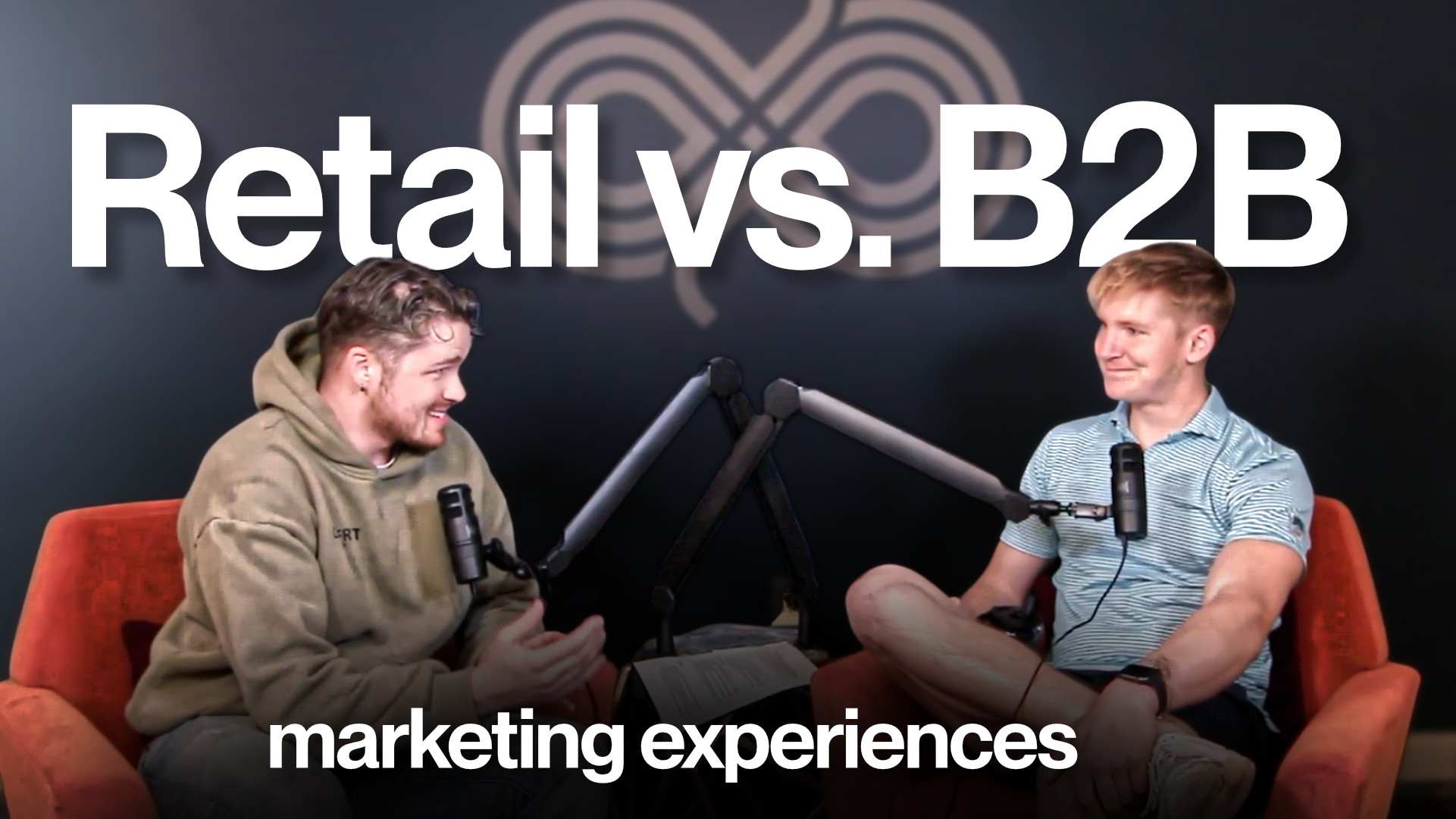
In this episode of Marketing by Design, Matt Lee, managing director and co-founder of Strategy Collective, explains why so many healthcare brands look and sound identical, and why that sameness is about to cost them. He also breaks down how to measure marketing against the schedule instead of the ad platform, and how he grew Strategy Collective from two partners into a 55-person team. If you market in healthcare, this is the conversation to have before your next rebrand or budget meeting.
For years, that logic held. Matt's old philosophy was simple: you don't have to outcompete the other consolidators or the big health systems. You just have to outcompete the doctor across the street who still has his name on the door and no marketing at all. That was not hard to do.
Here's what's changing. Consolidation keeps climbing. The doctor across the street is increasingly part of another platform with its own marketing team and its own agency. When everyone is running the same playbook, the fundamentals stop being a differentiator. They become table stakes.
That's when brand starts to show up in acquisition costs.
"Physician-led" is not a positioning
Matt had a line about this that I'll be quoting for a while. In the PE world, every group says it's physician-led. Great. Now everyone is. So what's different?
The same goes for "compassionate" and "patient-centered." Those words aren't wrong. They just don't separate you from anyone. Nobody is advertising that they're uncompassionate.
The practical exercise I took from this: write down the one claim on your homepage that your top three competitors can't also make. If you can't find one, that's the real project. Not a new color palette. A real point of view.
Humanize the process, not the condition
One of Matt's more surprising takes was that healthcare could use a little humor.
He's clear about the line. Don't poke fun at someone's condition. Nobody wants a joke about their cancer diagnosis. But the process of getting care is often ridiculous, and everyone knows it. The gown with the split in the back. The paperwork you fill out three times. The waiting room that runs 40 minutes behind.
Acknowledging that with a bit of wit does two things. It shows patients you understand what they're actually going through. And it makes your brand feel like it was written by humans, which is rare in this industry.
For healthcare marketers who are newer in their roles, I know this feels risky. Leadership is often front and center, and nobody wants to be the person who went too far. But the closer you can get to the line of not sounding like everyone else, the more your marketing will work.
Measure the schedule, not the ad platform
Matt's second strong opinion is on the data side, and it's the one healthcare marketers most need to hear.
Most marketers measure success by what the ad platform tells them. Matt argues you need to measure what the schedule tells you. Did a real patient book? Did they show up? What was that visit worth?
That sounds obvious. Getting there is not. In healthcare, your marketing source data and your practice management or EMR data live in completely separate systems. There's no shared identifier connecting an ad click to the patient who walked in two weeks later.
A lot of teams try to match on phone numbers. Matt says that gets you a 30 to 40% match at best. Adult children call to book appointments for their parents. Parents call for their kids. People call from work. To get real confidence, you have to reconcile across email, name, zip code, device data, and more, often 10 to 20 data points. And you have to do it in a HIPAA compliant way, which rules out dumping patient data into a general AI tool.
Roll-ups make it harder. Different locations run different EMRs, scheduling systems, forms, and call tracking. The usual answer is "put it all in a data warehouse," but that doesn't solve the normalization problem or the fact that many teams aren't capturing the right data in the first place.
Stage your attribution instead of boiling the ocean
What I appreciated about Matt's approach is that it's staged and realistic.
Stage one: did the appointment get booked? Use call tracking, scheduling platforms that accept marketing source data, and forms to tie a click to a booked appointment.
Stage two: did the patient show up? Online booking makes it easy to schedule on a Thursday night and forget by Monday. Show rate matters as much as booking volume.
Stage three: what was the revenue? This is where surgical practices especially need patience. A consult can take months to turn into a procedure. You don't want to measure the consult. You want to know whether the $80,000 surgery happened.
And before any of it, start with the basics. Matt works with groups that have hundreds of providers and can't tell him what an average patient is worth. Without that number, you can't know whether your acquisition cost is good.
His point on AI fits here too. If your data is wrong, AI won't help you. Get the capture right, and then AI can do a lot of the work.
How Strategy Collective grew to 55 people
The other half of our conversation was about building the business, and it's a story a lot of agency owners will recognize.
Matt was a partner at another agency, then spent about a year and a half as a CMO before starting Strategy Collective with his partner, Dominique James. A former client who sat on the boards of PE-backed healthcare groups walked them into their first clients.
The original model was lean. Matt and Dominique would act as fractional marketing leaders, then pull in a vetted collective of specialist freelancers and boutique firms for SEO, paid media, web, and branding. One of their first clients, Southern Veterinary Partners, had about 75 locations at the time. Matt served as their fractional VP of marketing and helped move them from 75 separate marketing efforts to one SEO strategy, one ads strategy, and one website platform. That group later merged and grew past 1,000 locations.
But the collective model had a weakness. When a partner didn't deliver, it landed on Matt and Dominique, because they were the ones accountable to the client. After getting burned a few too many times, they decided to build it their way. Since about 2021, they've grown from two people to roughly 55 full-time team members across the US, Latin America, Sri Lanka, and the Philippines.
That's a lesson I think about a lot running a lean studio. Outsourcing gives you flexibility. It doesn't give you control over quality. At some point, the reputation you're building is worth more than the overhead you're avoiding.
AI as the brain of the agency
I also asked Matt whether AI had shrunk his team. The answer was no. They're still growing every month.
Where AI helps is in three places: analyzing raw data quickly, supporting content research and outlines (never publishing a fully AI-written piece), and account management. Their AI is connected to their project management system, invoicing, contracts, email, and meeting notes, so it works like a brain for the agency with full context at all times.
He also uses it to answer RFPs he used to ignore. His observation: many RFPs are written by AI now anyway.
Matt's framing, as a lifelong violinist, is that you have to be the conductor of the orchestra. The strategy, taste, and voice have to come from you. As everyone's output starts to look polished in the same way, the bar on thinking goes up. That's true for agencies, and it's true for every healthcare brand trying not to blend in.
Key takeaways
- Cover the logo on your site. If it could be anyone's, you have a positioning problem.
- "Physician-led," "compassionate," and "patient-centered" are table stakes, not differentiators.
- Humor can work in healthcare when it targets the process of care, never the condition.
- Measure marketing against the schedule, not the ad platform.
- Phone number matching alone gets you 30 to 40% attribution at best.
- Stage attribution: booked, showed, then revenue.
- Know what an average patient is worth before judging acquisition cost.
- Use AI as the orchestra. You stay the conductor.
Resources mentioned
- Strategy Collective: https://www.strategyco.com
- Matt Lee on LinkedIn: https://www.linkedin.com/in/matthewtlee/
- Hampton: https://www.joinhampton.com
- My First Million podcast
- Join a community of high-performing marketers: https://columbusmarketing.org
- Need a healthcare website that actually converts? MMG Studio: https://www.mmg.studio
If you found value in this episode, please rate and review Marketing by Design on Apple Podcasts and Spotify! Your feedback helps us reach more high performing marketers like you.
Follow Us:
Stay updated and inspired with Marketing by Design:
LinkedIn: https://www.linkedin.com/in/mmgdesign/
And that, is marketing by design.