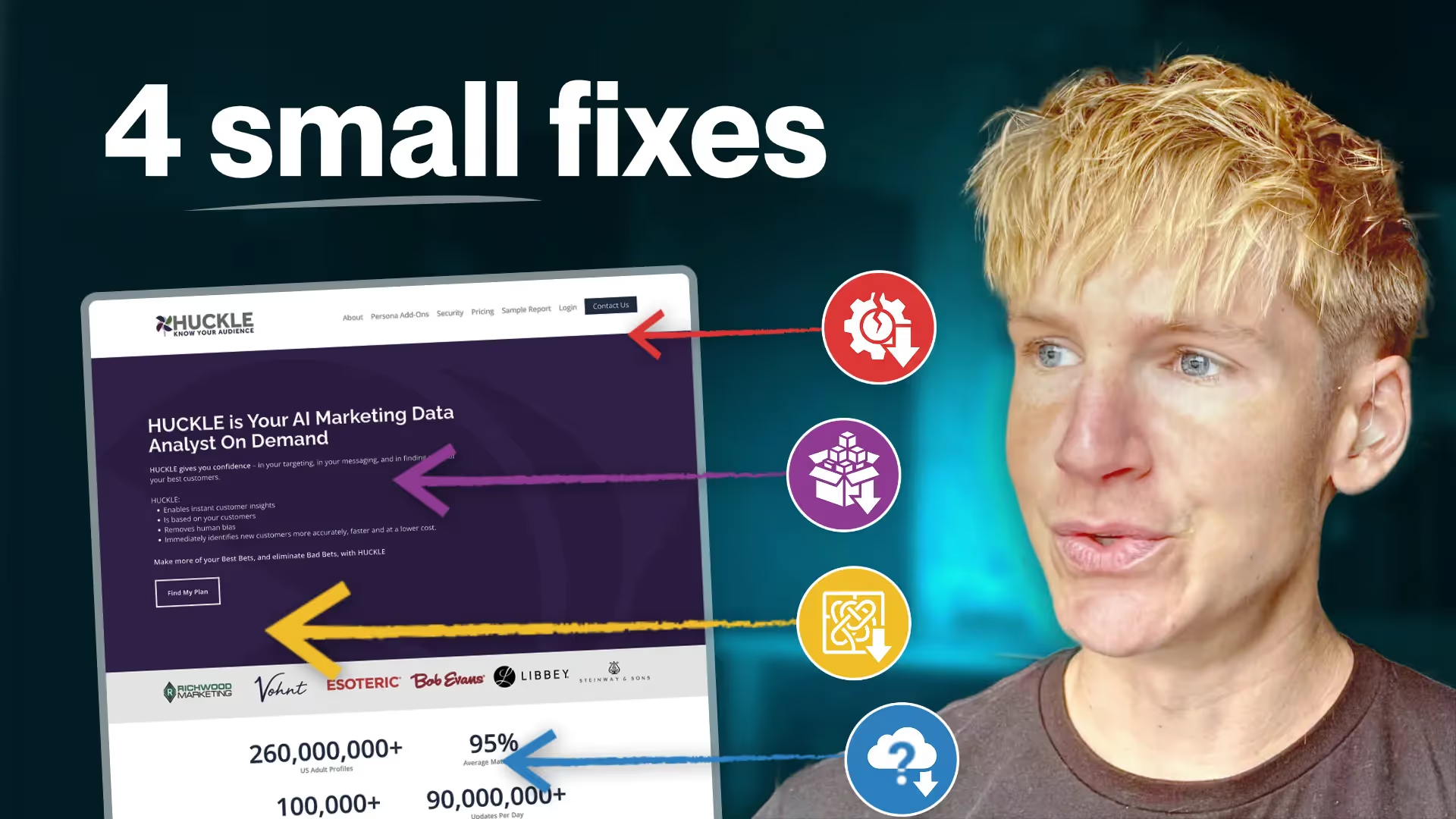
AI can build a decent-looking website in about four minutes. It still will not close the deal.
I got into this on a recent episode of Marketing by Design with Alexander Ferguson, co-founder of TeraLeap, and it is the clearest way I know to frame what has actually changed. When production gets easy, polish stops being the thing that separates you. Trust does. And in B2B and healthcare, where the buyer is spending real money in a regulated, high-stakes environment, trust is not a nice-to-have. It is the entire job of the website.
If you are sending paid traffic, referral traffic, or sales conversations to a site that does not earn that trust in the first few seconds, you are losing deals you should be winning. Here is how the best B2B and healthcare companies are fixing that.
Trust is now the whole job of a B2B website
Something structural shifted in the last two years. AI search and AI overviews have pulled a large share of traffic away from B2B sites before a human ever clicks. Fewer people land on your pages, which means the ones who do matter far more than they used to. The stakes per visit have never been higher.
Most teams react to this by chasing more traffic. That is the wrong first move. The higher-leverage play is converting the visitors you already earn, and getting found inside the AI answers themselves. That is exactly why we built out AI and LLM website visibility and healthcare SEO as core services. Showing up in a Google AI overview or a ChatGPT recommendation is the new front door. But once someone walks through it, the site has to do the hard part: earn the trust to keep them reading.
A website has three jobs, and all three are trust jobs. Answer the visitor's question in the exact moment they have it. Prove you have solved this problem for people like them. And make it feel like your team understands their world. Miss those, and no amount of traffic saves you.
What a healthcare buyer evaluates in the first few seconds
Marketers and healthcare decision-makers see an enormous number of websites. They are pattern-matching fast, and mostly below the level of conscious thought. In the first few seconds they are asking: do these people understand my industry, do they understand my problem, and can I trust them enough to keep going.
In healthcare, that judgment is stricter. A buyer is scanning for signals that you understand compliance, data handling, and the realities of a regulated environment. A site that looks generic, dodges the hard questions, or shows zero proof reads as risky, and risk is the one thing a healthcare buyer is trying to remove. This is the whole reason our healthcare website design work leads with credibility and compliance rather than decoration, and why HIPAA-compliant website design is not an afterthought bolted on at the end. When the environment is high-stakes, the design has to signal that you take the stakes seriously.
The "AI look" that quietly costs you credibility
Here is the uncomfortable part. When everyone reaches for the same tools, everyone's website starts to look the same. You already know the tells. The diagonal half-color sections. The little gradient blobs floating in the background. The same hover interactions and the same template layouts. Two years ago some of those patterns signaled "modern." Today they increasingly signal "built in an afternoon by a tool, not a team."
I use AI constantly, so this is not a purity argument. It is great for wireframes, ideation, and a lot of the technical work under the hood. What it should not do is design your finished, trust-earning experience for you, because sameness is the opposite of trust. When production becomes abundant, differentiation becomes the scarce thing, and differentiation is what buyers pay for.
Real differentiation does not come from a prettier gradient. It comes from actually talking to your customers, designing for their eyes and their objections, and building in the human elements a tool cannot invent. That is the philosophy behind how we approach website design and development: the look and feel matters, but it works in service of accessibility, structure, technical SEO, and proof, not instead of them.
Social proof is the one thing AI cannot fake
This is where Alexander and I completely agreed, and it is the single biggest lever most B2B and healthcare sites are leaving unused.
You can generate a decent layout. You cannot generate a real customer, at a real company, telling their real before-and-after story on camera. That asset is one of one. In a market flooded with good-enough sites, a genuine video testimonial or a specific, outcome-driven customer story is close to impossible to compete with. It lowers the perceived risk in a way nothing else does. It is almost biological. A buyer sees someone like themselves who succeeded, and they relax.
The mistake I see constantly is treating social proof as a destination instead of a layer. Companies build one testimonials page, dump everything on it, and move on. That page is one of the least-visited pages on the entire site. Only your warmest prospects ever reach it, which means your most persuasive sales asset is hidden from the people who need it most.
The fix is to treat proof like a material you build the whole site out of. Sprinkle short, sharp, one-sentence quotes near the decisions they support. Put at least some proof above the fold. Lead with faces, names, titles, and concrete outcomes, because a logo alone is weak and easy to fake. Use video wherever you can. And route relationships deliberately, which is why we treat our partners as a vetted network rather than a logo wall, and why the case studies and testimonials across the site are placed where buyers actually make decisions.
Where to place proof on a healthcare website
Relevance is the multiplier. A testimonial only lands when it comes from someone the visitor recognizes as themselves. Generic praise from outside your industry does almost nothing. A specific outcome from someone in the exact vertical does the heavy lifting.
That is why we build proof by segment rather than in one pile. A medical website design buyer should see proof from practices and health organizations. A pharmacy website design prospect should see pharmacy outcomes. A healthtech website design founder should see health-tech results, and a Medicare website design organization should see Medicare-specific proof right on the page where the decision happens. Matching the story to the visitor is the difference between social proof that decorates and social proof that converts.
One caution from real A/B testing: keep your high-intent conversion pages self-contained. Linking out to an external review badge from the page where someone is about to convert can send them straight into a list of your competitors. Give them the proof on the page, not a doorway off it.
Answer the question before they have to ask
The best test I know for any B2B or healthcare site is simple. If a prospect only used your website and never spoke to sales, would they have everything they need to become a customer? If the answer is no, your content and your FAQs have work to do.
FAQs are underrated as a conversion tool, and misused as a dumping ground. Instead of one giant FAQ page, put contextual questions on each page, answering the exact friction a visitor feels at that step. Base the questions on real friction from real customers. Where did they hesitate, what confused them about pricing, what felt unclear about getting started. In healthcare, that often means addressing compliance, data handling, and process directly, which ties straight back to HIPAA-compliant website design and to turning that clarity into pipeline through healthcare website lead generation.
And once you have earned the visit, do not waste the ones who leave without filling out a form. Knowing which organizations are on your site is its own form of trust-building on the sales side, which is what website visitor identification and broader website optimization are for.
When thin or outdated testimonials meet a redesign
Here is a real moment that happens mid-project. A team commits to a redesign, gets halfway through, and realizes their testimonials are old, off-ICP, or barely there. This is common, and it is not a reason to launch with nothing. Launching a B2B or healthcare site with zero proof is a trust red flag all on its own.
Something real is always better than nothing. If you are early or repositioning, use character testimonials from people who know and trust your team. Bring in partner and investor voices who can speak to the people and the vision behind the product. Then capture new customer stories quickly, ideally on video, and weave them into the highest-value spots as they come in. The goal is never to fake proof. It is to make sure the real proof you do have is working as hard as it possibly can.
Differentiation is the deciding factor
I will end where Alexander and I landed. In the next eighteen months, the B2B and healthcare companies that have not figured out differentiation on their websites will lose deals they should have won.
When every option looks good enough, buyers default to whatever is first available. You do not want to be merely available. You want to be the obvious, optimal choice, the one that clearly communicates how you are different from your competitors and from every other option in the buyer's head. Clarity, focus, and human trust are where you win when production is easy and noise is everywhere.
That is the entire thesis behind how we work at MMG Studio. You can read more about who we are and how we operate, and if you want a straightforward conversation about turning your website into something that actually earns trust and supports sales, get in touch. No pitch deck, no pressure.
For a deeper dive, the full conversation is on the Marketing by Design podcast. You can also read Alexander's original write-up, Beyond AI Templates: B2B Revenue That Converts, connect with him on LinkedIn, and see how TeraLeap captures video customer stories for B2B brands. Alexander also hosts the UpTech Report podcast if you want more of his thinking on storytelling and technology.
Want the shortcut? Grab our High-Converting Websites Visual Swipe File to see exactly how healthcare and B2B brands are building trust on the page.




.webp)
.webp)