If you work in B2B healthcare marketing, your website probably has problems that nobody is telling you about.
Not because your team doesn't care. Because the feedback loop is too slow. Website issues don't announce themselves the way a failed email campaign or a bad ad spend does. They stack up quietly over time, like eating one too many fries at lunch. You don't feel it right away. But eventually it shows up somewhere else: leads dry up, sales gets frustrated, and leadership starts asking questions you don't have great answers to.
The truth is, most B2B healthcare websites are making the same handful of mistakes. And because the people building and managing these sites are staring at them every day, they stop seeing the problems.
Think of it this way: we are fish in water. And sometimes, people are just too nice to tell us we're fat.
So let's fix that. Here are the three most common website crimes we see in B2B healthcare, and what you can do about each one.
Mistake 1: Vague Messaging That Kills Trust in Seconds
This is the fastest way to lose a visitor. If your homepage headline is unclear, people will start questioning everything else on the site before they even scroll.
Donald Miller has a concept called the grunt test. Imagine a caveman looking at the hero section of your homepage. If that caveman can't answer three questions, you've already lost:
Who are you? What do you do? What's in it for me?
That sounds simple. But go look at your homepage right now with fresh eyes. You might be surprised.
The headline problem
Here's an example we see constantly in healthcare: "Transforming Your Care. Learn How We Drive Innovation."
What does that mean? Who is this for? I have no idea what I'm looking at.
Now compare that to something like: "[Company Name] provides world-class resources and training to move healthcare outcomes forward."
That's a completely different experience. I know what you are. I know what's in it for me. And you would be shocked to learn that the vague version above was on the Mayo Clinic's website. If the Mayo Clinic can get this wrong, it can happen to anyone.
When your H2 is doing the H1's job
Another pattern we see all the time: the second headline on the page is more descriptive than the first one.
Example. H1: "When All Is Said, It's Done." H2: "AI-Centric Solutions for Human-Centric Medicine."
The H2 is doing all the heavy lifting. I know the product is AI-driven. I know it's relevant to medicine. That should be the H1. It's already on the page. Just swap them.
Your navigation is probably too clever
This one is huge. Most visitors don't scroll. If roughly 70% of your visitors are working with what they can see above the fold, your navigation needs to be crystal clear.
Here's what we see on most B2B healthcare sites: Products. Solutions. Learn. Company. Support.
What products? Solutions to what? Nobody talks like that. The only people who use the word "solutions" are people trying to sell us something, and we don't like it.
Try this instead. Instead of "Products," say "Medical Instruments" or whatever the actual thing is. Instead of "Solutions," use something like "Healthcare Research Data." Instead of "Learn," try "Healthcare Articles." Instead of "Company," try "About [Company Name]." Instead of "Support," try "Get Answers."
Small changes. Massive clarity.
How to see this in action on your own site
You don't need to guess where your visitors are getting lost. Open Google Analytics and go to the Explore tab on the left. From there, select Path Exploration. Click "Start Over" because GA4 likes to auto-generate graphs for no reason.
Set your starting point to "Page path and screen class" and select the backslash, which represents your homepage. This will show you exactly where people are clicking after they land on your homepage.
If you have descriptive URLs, the data gets even more useful. You'll see immediately which pages are getting traffic and which ones visitors are skipping entirely.
Don't forget your subheadlines
This applies beyond just the hero section. Anywhere you have a section headline, make it specific.
Bad example from an oral surgery center: "Our Center. Delivering Superior Results."
Better: "Staten Island's Premier Oral Surgery Center. Driving Outcomes for Patients Just Like You."
The more specific and personal the copy, the more your visitors feel like the site was built for them. That's what drives conversions.
Mistake 2: No Marketing Integrations on the Website
This one hurts because it's invisible. Your traffic and visitors are not going to convert themselves. But if you're not measuring anything, you have no idea what to improve.
As marketers, we should treat the website as the core of our entire ecosystem. It sits at the bottom of the sales funnel. It's the thing that answers all the key questions. It represents us to prospects, partners, investors, and leadership. And yet, for a lot of B2B healthcare companies, the website is the least instrumented part of their marketing stack.
A real story that should make you feel better (and then worry a little)
Earlier this year, we worked with a $5 million healthcare research company based in Arizona. They had been running their website for seven years. In all that time, they never set up form submission notifications.
When we migrated them to a new platform and finally got into their old WordPress admin, we found over 700 form submissions that nobody had ever seen or responded to.
One of those submissions? Novo Nordisk had reached out about two years earlier, interested in pursuing a case study.
Whether that would have closed, I don't know. But 700 missed form submissions over seven years at a company doing serious healthcare research work. That's not a small thing.
So if you're feeling a little behind on your website analytics, just know there are people out there doing this worse than you are.
Where to start with website measurement
The first step is to adopt an experimenter's mindset. We experiment with social. We experiment with email. Our websites should get the same treatment, and it doesn't have to be complicated.
Here's the basic hierarchy of what to measure:
Make it easy for people to contact you. This sounds obvious, but here's a stat from UX research: seven out of ten small business websites still don't include a call to action. If you have a button that leads to a conversion page, you're already in the top 30%. The bar is low. Clear it.
Use contact forms instead of just listing an email address. Forms give you way more control over the customer journey. You decide what information to collect, what the next step looks like, and how to route that lead internally.
Set up conversion events in your analytics. Track form submissions, button clicks, and page views on key pages. This gives you actual data instead of gut feelings.
Change things over time. The goal isn't to get it perfect on day one. It's to build a habit of testing and improving.
A quick example of what testing can do
We ran an A/B test on an exit-intent popup for one of our clients, a B2C health and wellness events company. In just two months, that popup generated over 500 leads and 300 paid conversions.
The popup itself was simple. Low-friction email opt-in so we could notify people about upcoming ticket drops. It got over 12,000 views and 561 form submissions, about a 4.5% conversion rate.
And the leads were real. We went into their Mailchimp account and verified them. Real email addresses, previous event attendees, high-intent buyers, all tagged properly in their mailing list.
You don't need a fancy tool to start testing. You just need to start.
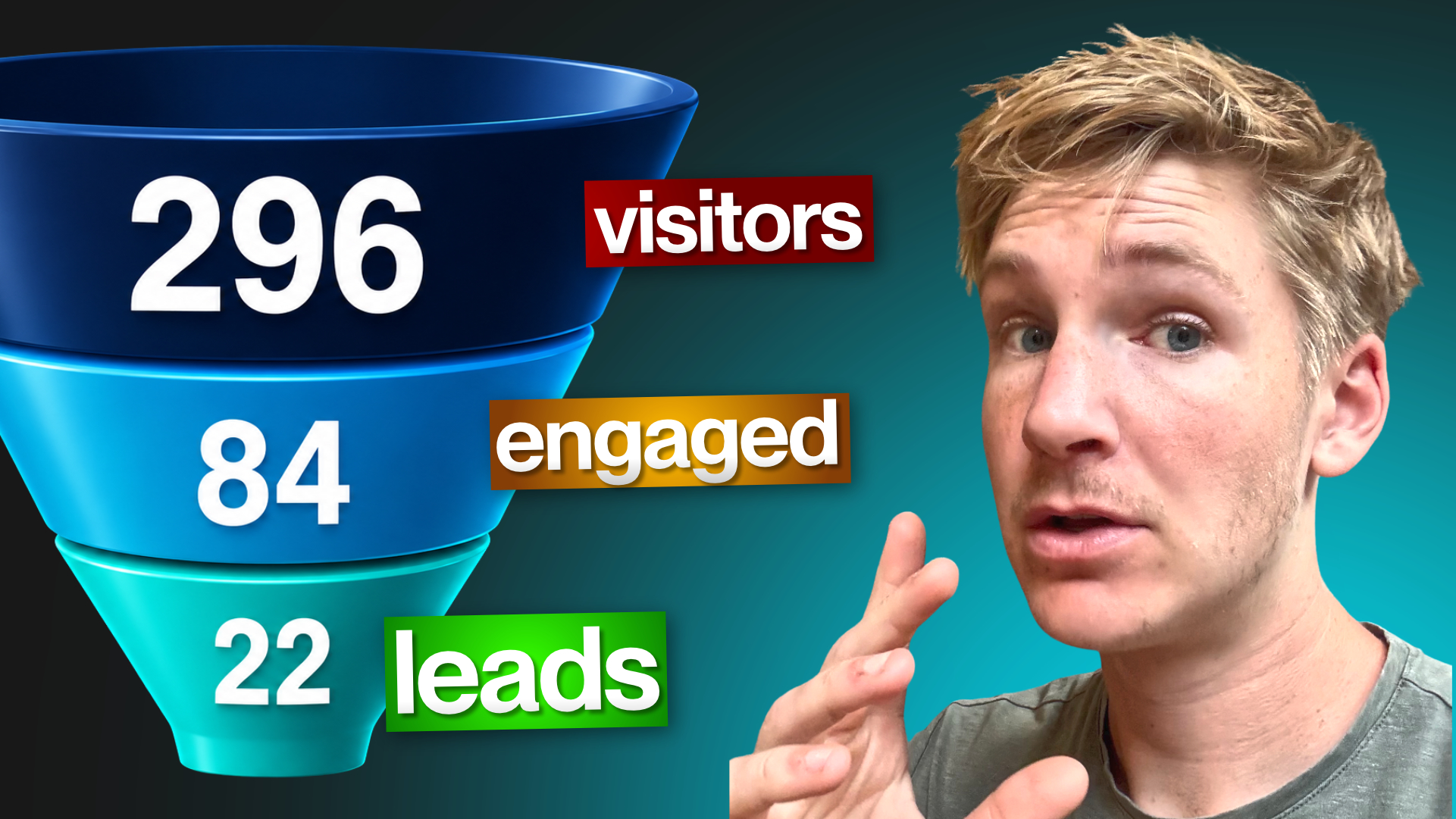
Once you have basic measurement in place, the next step is connecting it into one real funnel, visitors, engaged sessions, and conversions, tied together instead of living in separate reports. We walk through exactly how we build that for clients in how to turn your website into a sales funnel.
Mistake 3: UX and Design Choices That Get in the Way
Good UX is simple. A great experience guides users to where they want to go without making them think about how to get there. It answers their questions. And the design just stays out of the way.
When users aren't confused about how to navigate your pages, and they're not struggling to find the information they need, that builds trust. In healthcare especially, trust is the conversion event. Even if nobody says it that way out loud.
Here's where most B2B healthcare sites go wrong on the design and UX front.
People don't read. They scan.
If you have large blocks of body text on your pages, most visitors are skipping right past them. Use formatting to your advantage. Break things up with subheadlines, short paragraphs, pull quotes, and whitespace.
For your main value props, keep them to two lines max with a short descriptor underneath that reinforces the point.
Don't send visitors away at the point of decision
We work hard to get the right people to our websites. The last thing we want to do at the moment they're ready to convert is send them somewhere else.
Two common offenders here.
Social proof badges that link out. G2 badges, industry awards, "Top 50" lists. These are incredible trust signals. But if they're on a conversion page and they link out to a directory that also lists your competitors, you just handed your prospect an exit ramp. Keep the badges. Remove the links.
Social media icons on conversion pages. Andy Crestodina calls these "candy-colored exit buttons," and he's right. On the other side of those icons is cat videos and Dude Perfect clips. If you're going to include social icons, make them share-to links, not direct profile links. And definitely don't put them near your CTAs.
Be smart about stock photos and AI images
I get pushback on this one, but I stand by it. Stock and AI-generated imagery is sometimes necessary, but it needs to be done well.
If you have real photos, use them. Hire a photographer. Have them come in and shoot the team, the office, the product in action. Authenticity builds trust faster than any polished stock image.
If you have to use AI for image work, use it to refine an existing headshot or photo rather than generating something from scratch. Tools like Google AI Studio do a solid job of this. What you want to avoid is the uncanny valley stuff that comes out of mobile apps and cheap generators.
Stop using sliders
Auto-rotating sliders on websites are a bad idea. The data is very clear on this. Orbit Media Studios ran a test showing that every subsequent position on an auto-rotating slider decreases engagement by 15 to 20% at minimum.
It's already hard enough to get prospects to click a CTA. Making it a moving target just makes the problem worse. If you have a slider on your site, replace it with a single, strong hero section that does the job without asking your visitors to wait around.
The Common Thread
All three of these mistakes come back to the same root issue: we stop seeing our own websites clearly because we look at them every day.
Vague messaging creeps in because we already know what we mean. Analytics get neglected because nobody's asking about them yet. Bad UX sticks around because "it's always been that way."
The fix isn't a redesign. It's a willingness to look at your site the way a first-time visitor would and make the small, specific changes that add up over time.
If you're a B2B healthcare marketer and any of this sounded familiar, you're not alone. And you're not behind. You just need someone willing to point out the problems without sugarcoating it, and then help you fix them.
That's what we do at MMG Studio.







.webp)
.webp)